Polaris
↗Contentstack's context-aware AI assistant. I build its Mastra agents, from tools over product APIs to the evals that gate them, and architected its AG-UI frontend.
Mastra
domain agents + tools
Evals
gate every release
AG-UI
streaming frontend
Overview
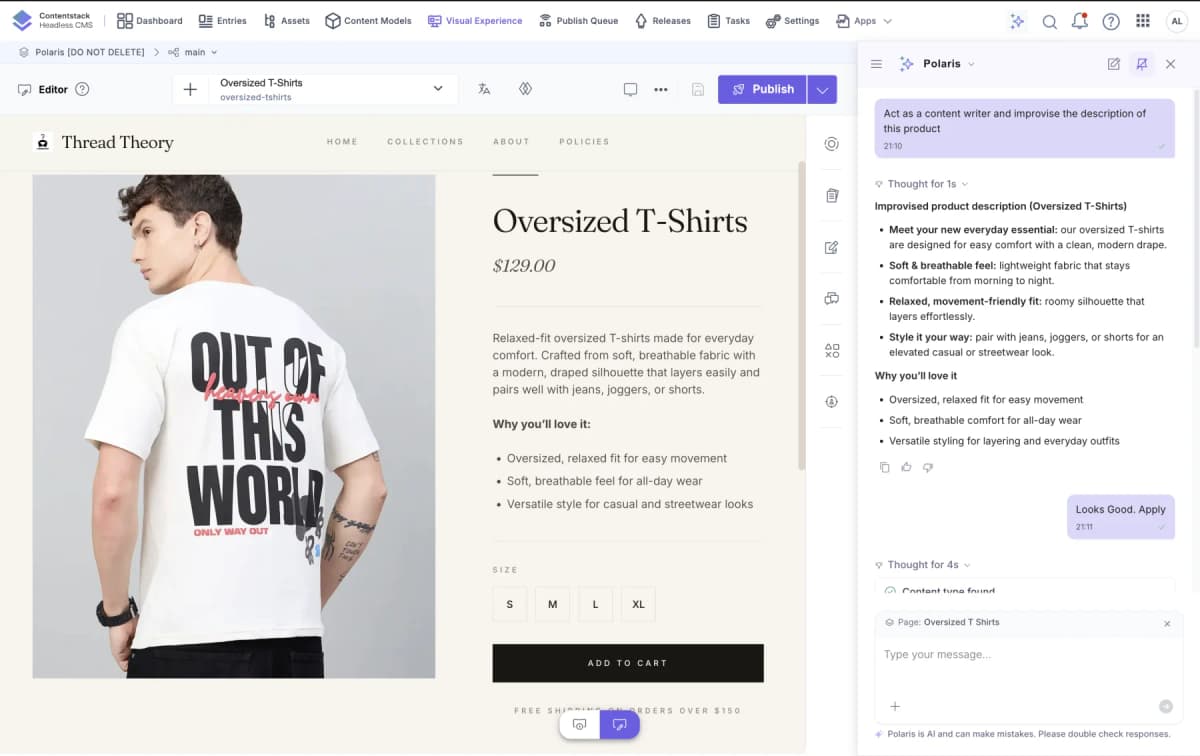
Polaris is the AI assistant built into Contentstack. Users describe what they need in plain language, and it plans and carries out the work across content modeling, entries, assets, taxonomy, and Visual Builder, aware of where they are in the product the whole time.
The challenge
Contentstack is a deep product, and every surface has its own data, APIs, and rules. The hard part was never the chat box. It was designing agents that understand the user's context, act through real product APIs across all of those surfaces, and do it safely enough that people trust them with their content.
The approach
Most of my work is in the agent layer. Polaris runs Mastra agents organized by product domain, and I own several of them end to end: deciding what each agent can do, designing its tools with validated parameters, mapping them onto product APIs, and checking the user's permissions before a tool ever runs. Eval suites score each agent's accuracy and catch regressions before release. On the front end, I architected the AG-UI interface, an rspack micro-frontend that streams the agent's reasoning, tool calls, and state into the host app and asks for confirmation before anything is written.
What made it work
Domain agents, owned end to end
I decide what each agent can do, write its tools with validated parameters, and map them onto product APIs, so one request becomes a planned, multi-step operation.
Guardrails and evals
Tools check the user's permissions before they run, changes wait for human approval, and eval suites gate each agent's accuracy before every release.
An AG-UI frontend
I architected the interface on the AG-UI protocol: an rspack micro-frontend that renders the agent's reasoning, tool calls, and state as live UI inside the host app.
Built with